The Historical Landscape: Post-Roman Wales
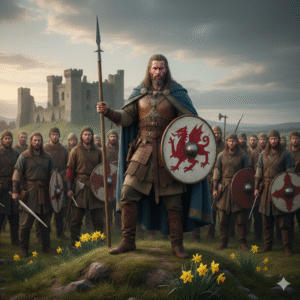
To understand David, one must understand the “Age of Saints.” Following the Roman withdrawal in 410 AD, Britain was a fractured mosaic of warring kingdoms and shifting loyalties. In Wales, a distinct form of Celtic Christianity began to flourish. Unlike the structured, urban-centric church of Rome, this was a faith of the wild: built on remote clifftops and in deep forests, led by holy men and women who sought God in the silence of the landscape.
David was born into this transition. Tradition holds that he was of royal blood—the son of Sandde, a Prince of Ceredigion, and Non, a woman of remarkable piety (who became a saint in her own right). His birth, occurring during a violent thunderstorm on a Pembrokeshire cliffside, was said to be so holy that the lightning didn’t harm his mother, but instead illuminated the path for his arrival.
The Rule of the Water-Drinker
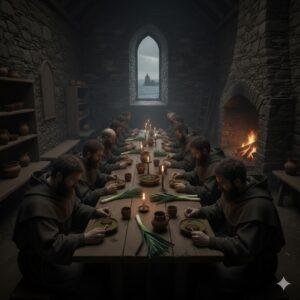
David’s path was not one of soft robes or easy living. He was educated by the blind monk Paulinus, and early on, he embraced a life of extreme asceticism. He became known as Dewi Ddyfrwr (David the Water-Drinker) because he rejected wine and beer, consuming only water and a meagre diet of bread, herbs, and wild leeks.
When he founded his monastery at Mynyw (now the city of St David’s), he demanded a discipline that would break most modern spirits:
- Manual Labour: The monks pulled their own ploughs without the help of oxen, believing that “every man should be his own ox.”
- Intellectual Rigor: Between hours of hard labour, they spent their time transcribing manuscripts and in deep study.
- Silence: Conversation was forbidden unless absolutely necessary, fostering a life of constant internal prayer.
The Miracle at Llanddewi Brefi
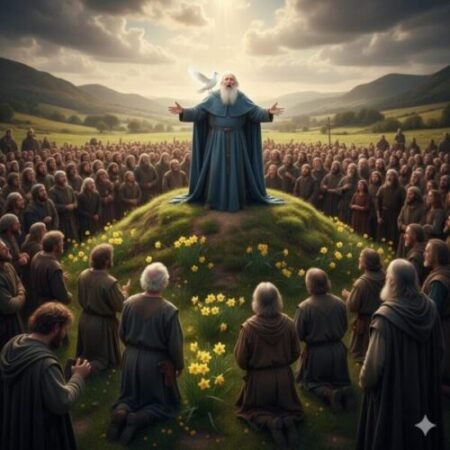
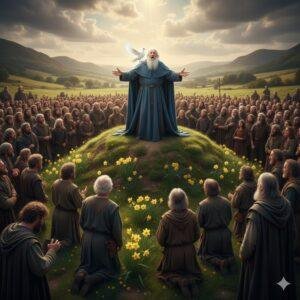
Perhaps the most iconic moment in David’s life occurred at
the Synod of Brefi around 550 AD. A massive crowd had gathered to debate
religious doctrine, but the ground was flat, and David’s voice—ever humble and
soft—could not be heard by those at the back.
As he spoke, the legend says the ground beneath
his feet rose up to form a small hill, lifting him above the crowd so his words
rang out clearly across the valley. Simultaneously, a white dove—the symbol of
the Holy Spirit—was seen to alight upon his shoulder. Today, the church of St.
David stands atop that very mound in the village of Llanddewi Brefi.
“Do the Little Things”
In March 589 AD, as David lay dying in his beloved Mynyw, he gave his followers a final charge that has become the most famous mandate in Welsh history:
“Arglwyddi, frodyr, a chwiorydd, byddwch lawen a chadwch eich ffyd a’ch cred, a gwnewch y pethau bychain a welsoch ac a glywsoch gennyf i.”
“Lords, brothers, and sisters, be joyful, and keep your faith and your creed, and do the little things that you have seen me do and heard about.”
This philosophy of “Gwnewch y pethau bychain” (Do the little things) remains a guiding principle in Wales. It suggests that greatness isn’t found in grand gestures, but in the small, daily acts of kindness, discipline, and devotion.
Legacy: From the Leek to the Cathedral
David was canonized by Pope Callixtus II in 1120, declaring that two pilgrimages to St David’s were equal to one to Rome. Today, his presence is felt every March 1st, when the streets of Wales fill with the scent of cawl and the bright yellow of daffodils—the flower that blooms to herald his feast day.
He transformed Wales from a collection of scattered tribes into a land with a unified spiritual soul. He wasn’t just a monk; he was the architect of the Welsh character: resilient, humble, and deeply connected to the earth.